Yes, Invisalign can fix crowded teeth for the large majority of patients, and in many cases the results rival what traditional braces can achieve. At Modern Orthodontics in New York, NY, our board certified orthodontic specialists have used clear aligners to correct everything from a single overlapping front tooth to more involved arch crowding, and the right approach always starts with understanding exactly how much space your smile needs. Below, we break down what determines whether aligners are the right fit for your crowding, how that space actually gets created, and when a different approach might serve you better.
This Article Will Address
- Whether Invisalign can really straighten crowded teeth
- How much overlap or crowding clear aligners can typically correct
- Why mild crowding tends to be an especially strong match for treatment
- How aligners create room for teeth without pulling any
- When traditional braces might be the more reliable option
How Much Crowding Can Invisalign Fix?
Invisalign can resolve mild to moderate crowding for the large majority of patients, and thanks to newer aligner materials, changes in attachment techniques, and advances with Artificial Intelligence, many severe cases now respond well too.
Orthodontists generally measure crowding in millimeters, meaning how much extra space the teeth would need to sit flat, straight, and evenly spaced along the arch. A tooth that overlaps its neighbor by only a millimeter or two is considered mild. Crowding in the four to six millimeter range is typically classified as moderate, and anything beyond that starts to be considered severet. At Modern Orthodontics, Dr. Cooperman, Dr. Romao, and Dr. Aboud evaluate every patient’s crowding with digital scanning and detailed imaging before mapping out a plan, since the word crowded can describe very different underlying situations depending on the patient.
- Mild crowding, roughly one to three millimeters of overlap
- Moderate crowding, roughly four to six millimeters
- Severe crowding, more than six millimeters, sometimes paired with a bite issue
The degree of crowding matters more than how the smile looks in the mirror, since two people with what looks like crowded teeth can actually need very different amounts of tooth movement. That is why an accurate diagnosis, not a quick glance, should always come before a treatment recommendation.
Advanced imaging plays a bigger role in this decision than most patients expect. Digital scans replace the old gooey impression trays, and AI assisted treatment planning software lets our doctors preview how each tooth is expected to move before a single aligner is made. That preview is often the clearest answer to how much crowding Invisalign can fix in your specific case, since it accounts for root position, bite relationship, and jaw shape rather than relying on a general rule of thumb.
Is Invisalign Good for Mild Crowding?
Mild crowding is one of the strongest matches for Invisalign, and most patients in this category see fast, predictable results.
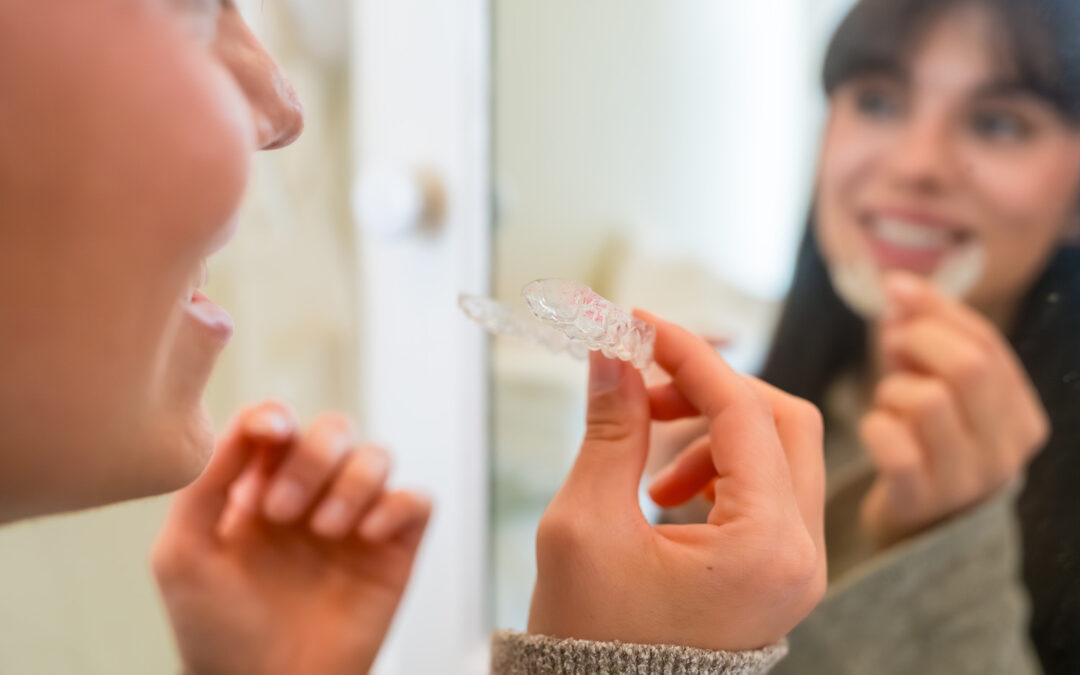
When teeth only need to rotate slightly or shift a millimeter or two, clear aligners can apply the gentle, continuous pressure required without the bulk of brackets and wires. Because the movements needed are smaller, treatment plans for mild crowding tend to be shorter than plans for more involved cases, and many patients complete treatment in well under a year. Aligners also make it easier to stay consistent with daily life, since they come out for meals and photos and go right back in afterward.
- Nearly invisible trays that fit into daily life without drawing attention
- A removable design, so there are no food restrictions during treatment
- Fewer in-office visits than most traditional braces schedules require
- A shorter overall treatment timeline for straightforward cases
Consistency still matters. Aligners only work when they are worn as directed, generally twenty to twenty two hours a day, so mild crowding cases that seem simple on paper still depend on the patient following through.
There is also a real health benefit beyond appearance. Overlapping teeth create tight spots where a toothbrush and floss cannot fully reach, which raises the risk of plaque buildup and gum irritation over time. Correcting even mild crowding tends to make daily brushing and flossing noticeably easier, which is part of why so many adult patients pursue treatment even when their crowding is barely noticeable to other people.
Does Invisalign Use IPR or Extractions to Create Space?
In most cases, Invisalign creates the space it needs through interproximal reduction, commonly called IPR, rather than removing any teeth.
IPR involves gently polishing away a small, precisely measured amount of enamel from between selected teeth, opening up just enough room for the aligners to bring everything into alignment. The amount removed is minimal and is planned digitally before treatment even begins, so there is no guesswork involved once you are in the chair. For patients who feel uneasy hearing this described as filing or shaving their teeth, it helps to know the process is quick, generally painless, and limited to areas that will not affect the strength or long term health of the tooth.
Extractions are reserved for the more severe end of the spectrum, when there simply is not enough room in the jaw for every tooth even after IPR, arch expansion, and other space creating strategies have all been considered. Our doctors will always walk you through exactly which strategy your plan relies on and why, so nothing about your treatment feels like a surprise.
When Are Braces Better Than Invisalign for Crowding?
Traditional braces may be the better option when crowding is severe, when significant tooth rotation or root movement is needed, or when a bite problem accompanies the crowding.
Brackets and wires apply continuous, highly controlled force in multiple directions at once, which makes them especially effective for the kind of complex movement severe crowding can require. In some cases, a hybrid approach, starting treatment with braces to resolve the more difficult movements and finishing with aligners, offers the best of both worlds. Patients with significant jaw discrepancies may also be candidates for orthognathic surgery alongside their orthodontic treatment, which is a conversation best had directly with your orthodontist.
The only way to know which path is right for you is a hands-on evaluation. Crowding that looks similar on the surface can call for very different treatment underneath, which is exactly why our doctors rely on digital scans and imaging rather than guesswork before recommending a plan.
This is also where working with a true orthodontic specialist, rather than a general dentist offering aligners as an add-on service, makes the biggest difference. Years of additional training beyond dental school go into recognizing which crowding cases will move predictably with aligners and which ones need the added control that braces provide.
Book Your Invisalign Consultation at Modern Orthodontics
If your smile is overlapping or tightly spaced and you are wondering whether clear aligners are the right fit, Modern Orthodontics is here to help. Our team, including Dr. Cooperman, Dr. Romao, and Dr. Aboud, welcomes new and returning patients at our Tribeca, Harlem, and Bronx locations, and we are currently scheduling consultations for anyone ready to start their smile journey.
We know busy schedules make it hard to prioritize a consultation, which is why we offer flexible booking by phone, text, or online at whichever office is most convenient for you. If you’re still weighing your options, our full range of orthodontic treatments is a good place to start. Call, text, or book online today, and let’s map out the plan that gets your crowding corrected the right way.
Visit our Invisalign page to learn more about clear aligner treatment, explore our homepage for an overview of our practice, or reach out through to schedule your consultation.
Sources
Clear Aligners: Discreet Ways to Straighten Teeth, American Association of Orthodontists

Dr. Maggie Romao
Born and raised in Brazil and a dual graduate of Columbia University (undergraduate and dental school), Dr. Romao completed her orthodontic specialty training at New York University in 2007. At Modern Orthodontics, she brings a warm, patient-centred approach to every smile transformation—drawing on her global background to connect with adults, teens and children alike. When she’s not helping patients achieve confident, healthy smiles, she enjoys life on the Upper West Side of New York with her three wonderful children.
Dr. Kenneth B. Cooperman
Dr. Cooperman earned his dental degree at Tufts University School of Dental Medicine in 1995 and went on to specialise in orthodontics at New York University in 2000. His career journey—from working with inmates in New Hampshire to his advanced training in multiple cities—reflects his commitment to precision, care and social responsibility. At Modern Orthodontics, he pairs technical expertise with a personable, transparent treatment style, ensuring each patient feels informed and supported. He lives on Manhattan’s Upper East Side with his family and their dogs, and brings that same sense of family-oriented care into the practice.